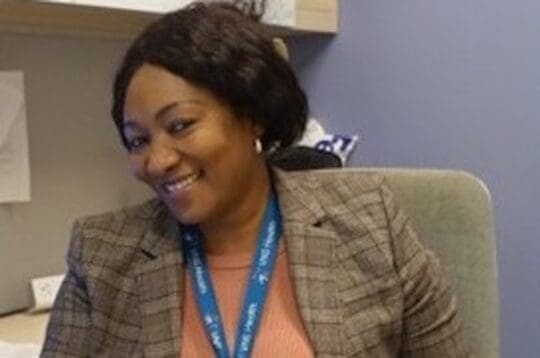
Staten Island News Org Profiles Jennifer Hansen, 2025 SLP of the Year
Staten Island’s Jennifer Hansen Recently Awarded VNS Health Speech Language Pathologist of the Year 2025
Local Hero To Patients Across Island With Communication Issues
The community health nonprofit VNS Health (formerly Visiting Nurse Service of NY) shared an inspiring story of a frontline hero, and Speech Language Pathologist, helping keep the Staten Island community healthy. I thought her story might be especially timely for an interview, as it is National Rehabilitation Awareness Month, and Jennifer was recently named “Speech-Language Pathologist of the Year” by VNS Health. For almost 20 years, Jennifer has been helping patients across Staten Island regain their voices, independence, and confidence—right in their homes.
A Staten Island native, Jennifer treats her patients like family. “Everyone knows everyone here,” she says. “Sometimes I’ll find I know a patient’s daughter, or I may have cared for the patient’s aunt or cousin.”
Her work is deeply personal and impactful. From helping a 9/11 first responder speak again after cancer surgery to supporting isolated seniors struggling to communicate, Jennifer’s care goes far beyond clinical.
She listens, empowers, and brings joy back into her patients’ lives. Jennifer also integrates mindfulness and gratitude into her practice, setting a daily “Gratitude Alarm” and using breathing techniques to help patients feel calm and supported.
Given the rise of speech and language disorders as Staten Island’s population ages more rapidly, I believe Jennifer’s story is especially pertinent for the local community, and it spotlights the vital role speech-language pathologists play in Staten Island’s community health landscape.
Additional information about speech language pathology, including selected questions and answers provided by Jennifer, are below. The video provides more details:
Staten Island has a growing population of older adults, with 14% of the community 65 and older, and that number expected to grow. While many older Americans are living longer, they are also dealing with a greater number of chronic health conditions that threaten their ability to stay independent. When it comes to health, many of us are aware of the importance of regular doctor visits, or having your nurse check in on you…but what doesn’t always get attention is the work of rehabilitation therapists who have a critical role to play in maintaining our health and independence.
Q: For people not familiar with the specialty of Speech-Language Pathology, can you explain a little about what it is a Speech Language Pathologist does?
Jennifer:
- SLPs are primarily focused on diagnosing and treating speech, language, voice, swallowing, and cognitive-linguistic disorders
- When most people think of speech therapy, they tend to think of it in terms of a young person who might have an articulation disorder or stuttering…but it’s much more than that
- Work with conditions like Dementia, Parkinson’s, stroke, and head/neck cancers
- Give examples of how these illnesses and the impact speech/swallowing
- And these disorders are more common than you might think—over 17 million Americans experience speech-language disorders
- Within the field, I work in home-based care, which is a unique specialty where I provide personalized, comfortable treatment where people are most comfortable—the home.
- We work to help find solutions—how can we help someone get back to doing activities of daily living so they can recover and become more independent?
- We collaborate closely with a team of other caregivers, including physical therapists, speech-language pathologists, nurses, home health aides, and family caregivers. It involves a lot of teamwork!
- While we work closely with patients to give them all the support they need, ultimately the goal is that our patients won’t need us after a certain point
- As I make my way around the neighborhood to my visits, it’s always great to see a former patient out and about, it makes the work we and the patients put in worth it!
Q: What inspired you to pursue a career in speech-language pathology?
Jennifer:
- Growing up, I had a real desire to help people and give back
- Initially wanted to work with children, but when my uncle was diagnosed with ALS, I saw how much need there was in care for adults—especially older adults
- Seeing how quickly it affected his ability to speak—it changed all aspects of his life, and I wanted to help others like him
- The ability to talk, to communicate, to eat, or simply to swallow are all things most of us take for granted—when we lose them it can take a toll on both physical and mental health
- I spoke to other SLPs, and it just seemed like the perfect job for me—so I pursued it!
Q: What drew you to home care, and what do you enjoy about it?
Jennifer:
- On a personal level, it gave me more flexibility for family life, caring for my own kids
- Patients are often more engaged with care in their own homes—they’re more comfortable, and that can make the dynamic easier as a clinician
- That said, sometimes people can be cautious at first, so I try and understand where they’re coming from, and share my own story. I’ve had to be a caregiver for my own family, and sharing that experience helps people open up
- I feel in many ways like I’m caring for my neighbors—many patients become like family, and as Staten Islanders—we are already a close knit community
- As SLPs our work is all about communication. Often, we end up helping patients with issues that go beyond our job description, like finding and linking them with the resources they need.
- Because we get involved with our patients’ lives on a more personal level, we become aware of issues they hadn’t been able to communicate.
- In someone’s home, I have a unique perspective on what their daily life looks like, and can better help them find the tools to get back to doing the things that help them live more independently.
Q: What are the most common conditions you treat?
Jennifer:
- Dementia and Parkinson’s are most prevalent
- We do home exercise programs with the patients and their caregivers to simulate them to try to keep up or recover a level of function for as long as possible
- With progressive illnesses, it’s about finding ways to adjust to change
- Challenges include speech loss, swallowing issues, and behavioral changes
- Focus on caregiver training and safe, least-restrictive diets for those with swallowing or eating challenges
Q: How important is it to help someone become be more independent?
Jennifer:
- As an adult, I think most of us want to live where we are comfortable, stay with routines we like, and make our own choices
- Mental health plays a big part in this job as well…
- For some patients, there can be frustration when you can’t do things you once took for granted…from eating on your own, to being able to communicate your wants/needs
- For many of our patients, we might be the only people they see in person or talk to all week
- I find it important to focus on the positive, but if there are signs of something more serious, like anxiety or depression, there are social workers on our teams who can help families connect to resources
- I encourage them to find positive ways to regain strength—getting out in the sun, maybe it’s describing what they see on a walk…
- I try to put myself in someone else’s shoes, and I can understand why they might feel frustrated, but I also use that to help them see the positives in their lives or in the situation. If we focus too much on negative, that’s all we can think about
Q: How do you support family caregivers?
Jennifer:
- Caring for a loved one truly is a labor of love—and not without its challenges, and it’s common for caregivers to feel some amount of “burnout” (if you want to share personal examples, could share here)
- In helping someone relearn how to communicate or regain the ability to swallow and eat safely, we’re helping the person to continue to live at home and in their community.
- We’re giving them hope — and because you’re often working with their families to find ways to motivate and inspire their loved one, we’re giving their families hope, as well.
- For caregivers: I often try to offer practical tips (e.g., calming music, outdoor walks, engaging activities)
- I also educate caregivers on how to integrate therapy into daily life
- It’s important as a clinician to build trust through empathy and shared experiences
Q: How do you stay positive in such a challenging field?
Jennifer:
- I work to practices daily gratitude (even set phone alarms!)
- I also draw strength from personal loss and my own experiences, and that helps me connect with patients and build more empathy
- Positivity attracts more positivity!
- When you start to feel negative or negative thoughts start, I often encourage people (or myself!) to think of three things you’re grateful for
Q: What advice would you give to someone considering this career?
Jennifer:
- This work is challenging but deeply rewarding—being able to see your neighbors, your community members recover and regain independence
- There’s flexibility and lifelong learning—no two days are the same!
- I would encourage people interested in SLP to explore the many paths within the field—home care was the best fit for me, but there are many different environments or teams on which you can work.
From their original release about the award:
VNS Health’s 2025 Speech-Language Pathologist of the Year has been revealed: It’s Jennifer Hansen—and the announcement is sure to generate a round of applause across Staten Island.
One of just two VNS Health speech-language pathologists (SLPs) in Staten Island and a resident of the borough herself, Jennifer treats all her patients like family. “Everyone knows everyone here,” she says.
“Sometimes I’ll find I know a patient’s daughter, or I may have cared for the patient’s aunt or cousin. They all feel like family.”
Jennifer has been with VNS Health Home Care for 19 years, and she finds every day rewarding, especially now that she’s past the hustle and bustle of raising young kids and being new on the job. What she loves most about her work is that she’s making a difference in the lives of her clients. They’re often isolated and lonely when she first meets them—they may be unable to socialize over a meal, for example, or be struggling to communicate with friends and loved ones.
“Besides losing their ability to be understood or to eat, they’re also losing their independence—everyone’s making decisions for them,” she says. “When I talk to them, I listen and I make sure to include them in the decision-making process. I can see that it cheers them up.”
Her colleagues praise Jennifer for how her work embodies VNS Health’s Core Values of Empathy, Agility and Integrity. For a time, she was VNS Health’s only SLP on Staten Island, and she knows the borough intimately. In one of her most memorable cases, she helped a 9/11 first responder regain the use of his voice after his larynx was removed during cancer treatment. On her first visit, she helped him set up and use a new electrolarynx. “He began talking up a storm! He was ecstatic, and I was ecstatic,” she recalls.
When another client she’d worked with numerous times over the years recently passed away, the family let Jennifer know how grateful they were for all her support. “They told me how much of a difference I made in their mother’s life,” Jennifer says. “That kind of feedback makes the job so rewarding.”
Jennifer always knew she wanted a career helping people. While in college, she was introduced to speech-language pathology through her boss at the deli where she worked, whose wife was an SLP.
Around the same time, Jennifer’s uncle was diagnosed with ALS and lost the ability to speak. The confluence of events inspired Jennifer to become an SLP herself, and she’s found it to be an ideal way for her to contribute to people’s quality of life. Gratitude is a big part of Jennifer’s life, as is yoga and meditation. She often weaves gratitude into her patient care, along with relaxation techniques and breathing awareness. She also sets a Gratitude Alarm on her phone that chimes regularly, reminding her to acknowledge things she’s grateful for. Her job at VNS Health tops the list. “I just enjoy my work so much these days,” she says. “In a way, it feels even more appropriate to get this award now.”