
Happy National Nurses Month!
We Asked VNSNY Nurses: “In these challenging COVID-19 times, what have you found to be most rewarding? A moment that’s made you say to yourself: ‘I’m proud to be a nurse!’”
VNSNY’s nurses have been on the front lines of the COVID-19 pandemic since it first struck our region in early March, and it has not been easy. In recognition of National Nurses Month, Frontline asked nurses from across the organization: What have you found to be most challenging about these last two months, and what have you found to be most rewarding—those moments that make you say to yourself, “I’m proud to be a nurse!”?
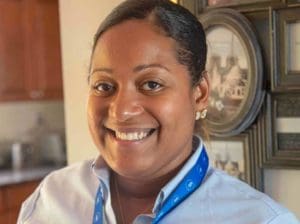 “Doing whatever I can to help the NFP women I serve get what they need.”
Adelmis Grano De Oro, Nassau County Nurse-Family Partnership
“Many of the NFP mothers I serve have been directly affected by the virus, whether it’s due to loss of jobs and income, or due to the families getting ill themselves. They might have a mom, a dad, and a baby living in a single room in a shared apartment, now faced with the challenge of having to isolate and provide for themselves. And they may not know or trust anyone in the community who can help them. 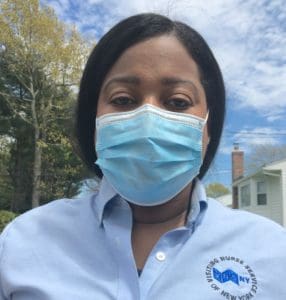 I’m working remotely now, but I still do whatever I can to help them get what they need—reaching out to food pantries that will deliver, getting them basic necessities for the baby, that sort of thing. But there are moments when I feel helpless… when I end a call and I just want to cry. At the same time, I’m grateful that I can be there for them, because it’s very possible that a family in the next room, in the same situation but not on the NFP program, has nobody to help them. That puts things into perspective, and makes me feel more effective with the families I do serve, even with the limitations.”
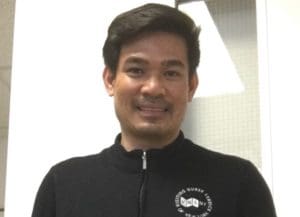 “Performing a courageous act of kindness.”
Eugene Roque Tampus, Home Care Nurse, Westchester Branch 1
“Most of my patients are in Yonkers, which has the highest number of COVID-19 cases in Westchester. I was initially a little nervous, even scared. Looking back, when I first became a nurse, I never thought it would come to this! Luckily, I was able to change my thinking pretty quickly. As a healthcare worker, who is better suited to care for people in need? We are like shepherds, and a shepherd cannot run from his flock. I see it as a true call for unity. I believe the best way to alleviate fear is to do a courageous act of kindness, and I’m so grateful that, as a nurse, I have an avenue for doing that. At this point, my greatest challenges are emotional ones. Many of my patients are not only alone but lonely too, and I can only imagine how distant they feel. On the other hand, all of us are feeling that way to some extent. We all look forward to a day when we can hug and be socially close again. But even though we can’t get too close right now, I see how happy it makes my patients just to talk for a couple of minutes. That’s enough to pacify any anxiety, and that’s what keeps me going.”
 “Keeping things running as smoothly as possible to ensure no patient is left behind.”
Mary Ann Arneel, Clinical Director, Regional Intake, Business Development
“My responsibilities as Clinical Director for Regional Intake in Business Development are to oversee day-to-day operations, consisting of on-site managers and clinical and non-licensed staff working within our referral sources to identify patients in need of home care. The COVID-19 pandemic required intake staff to telework. Not being on-site and not having the ability to perform on-site assessments created many challenges. One of Intake’s biggest virus-related challenge was getting remote EMR access and getting everyone set up to work from home. 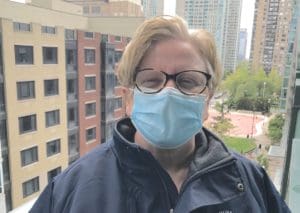 It was a little hectic at the start, but it went much more quickly than anticipated and people acclimated very well. Our main focus was on keeping things running as smoothly as possible and ensuring no patient was left behind. Communication was key—maintaining emailing logs, making sure we were looking at our pending lists, updating our cases. Our patient-facing staff quickly adapted to working remotely, keeping close communication with hospitals, nursing homes, doctors, social workers and case managers. What made me most proud was how understanding and supportive the staff were. Everyone stepped up to the plate and was willing to change their schedules, alternating weekends and cross-covering referral sources they hadn’t covered before—and doing it virtually, which isn’t always easy. They did whatever they had to do to ensure our patients received the care they need at home.”
 “Coming up with creative ways to support patients and expedite services during these stressful times.”
Jacqueline Kassman, Clinical Liaison, Advanced Illness Team, Care360° Solutions
“I work with patients and families who are dealing with significant disease and need assistance in advance care planning. While some need support while they undergo treatment, others want a more palliative approach, at which time we introduce hospice services and assist in facilitating a referral to a hospice of their choice. One of the challenges we’re facing is clients declining services due to concerns about potential exposure to COVID-19. Hospices are also overwhelmed by an onslaught of referrals, and are short-staffed due to personnel becoming ill, which can delay services. VNSNY has come up with creative ways to support patients and expedite services during these stressful times. One of the gravest concerns families have is knowing they’ll be isolated from their loved one should that person be hospitalized. They also fear that hospitalization increases the chance of loved ones getting infected. Hospice provides interventions and support to keep hospice patients at home. I feel that I made a difference, knowing that they were surrounded by loved ones and did not die alone. I’m also proud of how VNSNY staff has come together to help support each other psychologically through this crisis. Several of us have also lost friends, colleagues, or family to the virus.”
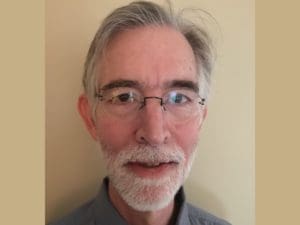 “Working with amazing, supportive coworkers.”
Charles Meys, Hospice Nurse, Manhattan
“The virus changed a lot of things about my job, like cutting down on visits to many of my clients’ homes. But there’s also something to be said about virtual visits. You can accomplish quite a lot in a FaceTime or WhatsApp conversation, so it’s not a bad thing; it’s just a new way of doing things. The most harrowing part of my day is using public transportation to get to the patients I do have to see in person—the ones who have drains or who require advanced wound care, for example. 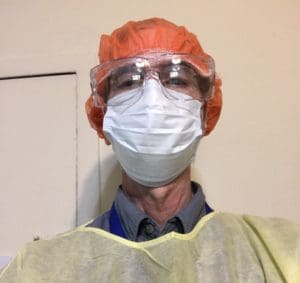 When the initial social distancing began, the situation was okay because there were fewer people on the trains, but then they started running fewer trains, so the cars got more crowded. And may the gods bless the homeless—they have nowhere else to go—but there’s a much larger homeless population in the subway now. But then I take a deep breath (once I’m off the train!) and realize that I am not alone—we are in it for the long haul, and we’re all in this together. What makes this job most rewarding is to work with such amazing, supportive coworkers, where everyone is stepping up. That makes it easy for me to keep going.”
 “Being there for the mother of a patient in her time of need, when she was dealing with so much.”
Sheryl Jarvis, Home Care Nurse, Bronx Branch 2
“It’s really been scary. I have family from all over the world calling me because they’re worried I’ll get infected. It’s really my family that’s making me the most anxious. This virus has taken a toll on all of us, both at work and at home. Everything is harder now because so many clients are affected in so many ways. I have one patient whose daughter left the state to escape the virus, but she texts me ten times a day about her mom. I want to help, but it gets to be too much at times. The rewards are built in to the challenges. I was visiting a patient in his 30s with severe epilepsy who lives with his mother. While I was there, his mother got a phone call that her sister had just died of COVID-19 at a nursing home. The sister’s husband had died two weeks earlier. So she was going to have to bury both of them. She, was crying, and the visit wound up lasting three hours instead of the usual one. But I felt so happy that I could be there for this woman, who was dealing with so much, in her time of need.”
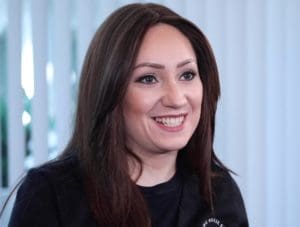 “Seeing the community show their gratitude and respect for us by following social distancing and wearing masks.”
Marina Elnatanova, Home Care Nurse, Queens Branch 1
“When the virus started happening it was frightening, because there was a 50/50 chance that you wouldn’t get the truth out of patients and their families. Sometimes they were symptomatic but in denial, so they didn’t divulge their symptoms. Or they were desperate—I visited one client who admitted to me that he was trying to open a case for his infected dad. So we’d be there in those homes, trying to navigate this crisis for ourselves and for our patients. But there’s been a real change over the last few weeks.  VNSNY is protecting us by replacing many face-to-face visits with video or telephonic communication, so the patients aren’t deprived of their visits but they remain safe and avoid rehospitalization. VNSNY has been really on top of providing us with education and emotional support. It’s also rewarding to get the recognition from our patients and their families, who have come to truly appreciate what we do. And it’s been wonderful also to see the community showing their gratitude and respect for us by following social distancing and wearing masks.”
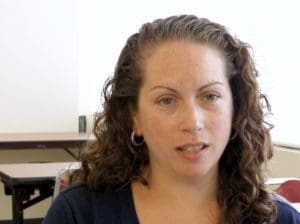 “Seeing people recovering, coming home from the hospital, getting better.”
Jessica Franzese, Home Care Nurse, Brooklyn Branch 4
“Close to half of my patients are COVID-19 patients, but I’m honestly not nervous about seeing them. I like getting out there. I mean, I love my husband and daughter, but being stuck at home, not working, watching the news all day, can drive you crazy! The biggest hurdle for me, as a home care nurse, is working from my vehicle, braving the elements, navigating all the PPE, taking off my jacket and only taking in what I need before entering a home. I have a huge blue bin full of masks and gowns in the back of my car. I put my patients’ minds at ease by preparing them beforehand—they know I’ll be wearing PPE, and they know that I see my non-COVID patients in the morning and my COVID people in the afternoon, so there’s no cross-contamination. On the bright side, I started noticing a real shift around Easter weekend. It’s funny—you can feel it in the streets. Things have gotten calmer. I’m inundated with work now, but it’s good work–-it’s people recovering, coming home from the hospital, getting better. And that’s a story that you don’t hear about a lot in the news.”
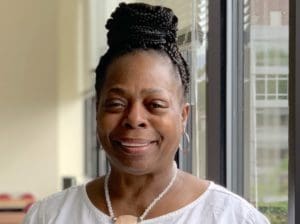 “Collaborating and remaining committed that no patient be left behind.”
Shawne Browne-Delaney, Nurse Care Coordinator, CHOICE MLTC
“As a care coordinator for the CHOICE MLTC program, I provide case management to our members, who are faced with multiple diagnoses including diabetes, cardiac and respiratory conditions, and dementia. Upon admitting a member, our team creates a patient-centered service plan. We then follow up with our members monthly or when needed to holistically ensure they are compliant with their medical provider visits, diet, medication and equipment needs, so they can maintain themselves safely in the community. I’d say that COVID-19 has increased my workload. Our members are afraid. Maybe their home health aide or family member got sick and can’t visit anymore. Many have unrealistic expectations—they expect the same routine, COVID-19 or not. I let them know that I understand, but this is a collaborative effort between CHOICE MLTC and the families. I find myself giving a lot of continuous emotional support now, and often share mantras like ‘this too shall pass.’ I make every call educative and encouraging, which calms and empowers clients. I’m grateful that our assistant VP, Esther Conteh, implemented case-management telework four years ago, because we were well-equipped to work remotely when the crisis occurred. As an 18-year member of CHOICE MLTC, I’m very proud of our collaborative spirit. Even during this pandemic, we remain committed that no patient be left behind.”
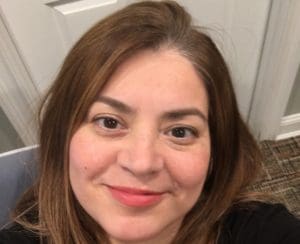 “Being there for people, especially now that so many are isolated.”
Maria Alvarez, Nurse Field Supervisor, Partners in Care
“My job entails going to clients’ homes, completing health assessments, developing care plans, training home health aides, and ensuring that clients get what they need and that the home is safe for them and their aides alike. When the virus hit, many clients were afraid and didn’t want people coming to their homes. One new challenge was having to work by phone—not being able to use my eyes and ears to assess a situation. You have to learn to listen for signs and clues, which isn’t always easy. I have a caseload of about 300 clients, and some of them have many HHAs, so I’m on the phone with fearful clients and HHAs most of the day. On the plus side, I’m so happy that I’m able to be there for our clients, especially now that so many are isolated. I’ve been able to offer assistance and condolences to families when clients passed away. When I called to check in on one of our HHAs who’d gotten sick—she’d been a day away from being put on a respirator—she was truly thankful. She called me again when she’d recovered, crying, because her family was afraid of her—scared that she was still contagious. The experience had left her with PTSD. Being able to be there for her, to calm her and to get her help through various resources, felt great.”
In case others find these helpful, here are the support resources that Maria connected her HHA colleagues with:
New York State Emotional Support Helpline: 844-863-9314
The 1199SEIU Member Assistance Program: 646-473-6900
VNSNY Partners in Care HHA Support Email: [email protected]


